

What Happens During a Professional Home Pest Inspection?
October 5, 2026
You already know something is wrong.
Maybe ants are showing up in the kitchen every morning. Maybe you hear scratching in the attic at night. Maybe you found termite evidence, a gopher is tearing up the yard, or something with wings has decided your home is now theirs too.
At that point, the last thing you want is a sales pitch.
You want someone who feels more like a knowledgeable neighbor than a salesperson—someone who comes to your home, listens to what is happening, looks for the real cause, and explains what actually needs to be done.
That is what a professional home pest inspection should feel like.
A good inspection is not about walking around for five minutes, spotting one pest, and immediately recommending the largest service package available. It should involve identifying the pest, locating the activity, figuring out how it got there, and determining whether conditions around the home could allow the problem to continue.
If you are having a pest-control company come to your home, here is what you should expect.
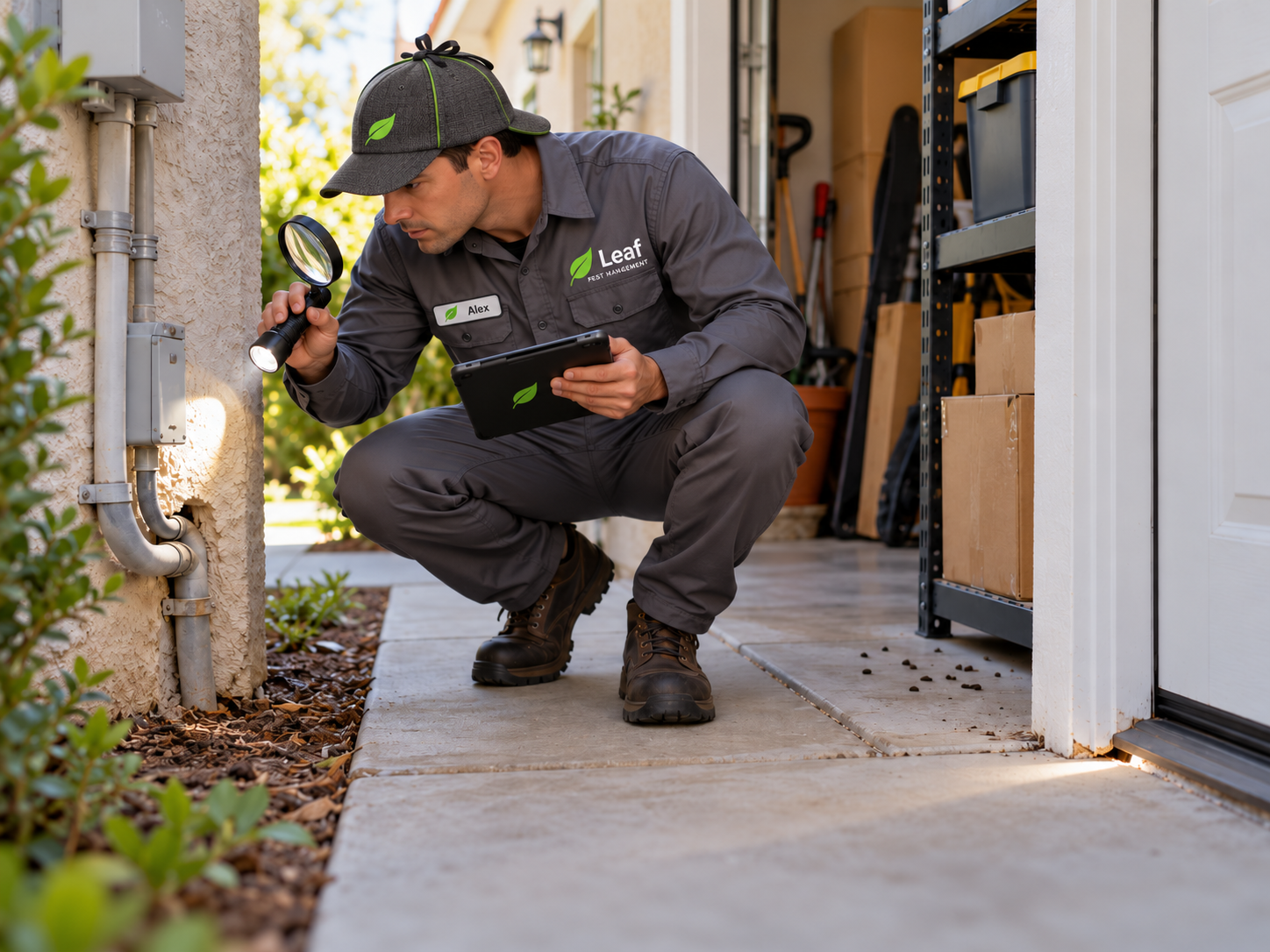
Did you get a sales guy or the Sherlock Holmes of Pest Control?

This is where you can usually tell what kind of inspection you are getting. A salesperson tends to look for enough evidence to recommend a service. A good pest-control technician looks for enough evidence to understand the problem. That means they should not stop at the kitchen counter because that is where you saw ants. They should not stop at the garage because that is where you found droppings. They should not simply spot one spider and decide the answer is “spray the house.”
Pest Control Investigation
A thorough technician should be looking at things like:
- Where the pest was seen
- What evidence is nearby
- How the pest may be entering
- Whether there are food or water sources
- Whether moisture is contributing
- Whether landscaping is creating access
- Whether the activity is isolated or established
- Whether there are signs in other parts of the property
They should also be looking for evidence even when no live pest is visible.
That can include:
- Droppings
- Gnaw marks
- Grease marks
- Shed skins
- Egg cases
- Webs
- Ant trails
- Nesting material
- Mud tubes
- Wood damage
- Burrows
- Entry holes
- Unusual odors
The pest itself is only part of the story.
The better question is:
What clues explain why this pest is here, how it got in, and what is allowing it to stay?
That is the difference between someone trying to sell you pest control and someone actually diagnosing a pest problem.
Did the Technician Explain What They Found?
A good inspection should leave you with answers, not a vague “we found activity.”
The technician should be able to explain:
- What pest they believe is present
- Where they found evidence
- How active the problem appears to be
- Where the pest may be getting in
- What conditions are helping the problem continue
You should not need a pest-control license to understand the explanation.
If they found rodent droppings in the attic, they should show you where. If ants are entering around a plumbing line, they should point it out. If they suspect termite activity, they should explain what evidence led them there. A professional should clarify the problem—not make it more confusing.
Did They Explain Why the Pest Is There?
Finding the pest is only half the job.
The next question should be:
Why is it here?
Most pest problems are connected to something around the property.
It could be:
- A gap around a pipe
- A damaged door sweep
- Overhanging tree branches
- Standing water
- Leaking irrigation
- Pet food outside
- Fallen fruit
- Clutter in a garage
- Moisture under a sink
- An attic vent that is not properly sealed
The technician should be connecting the dots for you. A rat in the attic may be entering from the roofline. Ants in the kitchen may be following moisture or food. Spiders in the garage may be there because other insects are already thriving nearby.
The goal is not just to kill what is there today but to protect you year-round.
Pest Control 1-time vs Packages

Not every pest problem recurs.
Sometimes a one-time treatment is enough.
Sometimes exclusion work is the priority.
Sometimes recurring service makes sense because the property has ongoing pest pressure.
And sometimes the answer is surprisingly simple.
A professional should explain your options and why each one may or may not fit the situation.
You should understand:
- What they recommend
- Why they recommend it
- Whether follow-up is needed
- Whether the service is one-time or recurring
- What is included
- What is not included
You should never feel like the inspection was just the first step in a predetermined sales script.
Common Pest Control Pricing and Packages
Pest-control pricing can vary widely depending on the pest, home size, and how much work is required.
For Greater Los Angeles and Ventura County, typical 2026 ranges look roughly like this:
- General one-time pest treatment: about $140–$375
- Recurring pest-control service: roughly $90–$185 per visit, depending on frequency and coverage
- Rodent control/exclusion: often $450–$1,500+ when entry-point sealing is involved
- Gopher control: generally $150–$500, depending on yard size and activity
- Termite spot treatment: roughly $250–$1,500
- Larger termite treatments or fumigation: can run into the thousands of dollars
Local Ventura County programs currently advertise recurring residential plans around $94 every two months to $139 per month, while broader 2026 Los Angeles market estimates put one-time general treatments around $150–$375.
The important part isn't whether your quote lands in the middle of a range.
It is whether the technician can explain why your home costs what it does.
A 1,500-square-foot home with a small ant problem should not be priced the same way as a large property with rodents in the attic and multiple entry points that need exclusion work.
If the price goes up, the scope of work should make it obvious why.
Was initial pricing discussed?
There should be no mystery. Before treatment, understand the costs and what you're paying for. For issues like rodents or termites, a technician may need to inspect first for an accurate quote. It’s important to clarify the total price, any included follow-ups, ongoing agreements, renewals, what happens if the problem continues, and what work is included in the quote.
Clear pricing is part of a professional inspection.
Did They Tell You When You Did Not Need Something?
This may be one of the best signs that you hired the right company.
Sometimes the right answer is:
“You probably do not need a major treatment.”
Maybe the issue is minor.
Maybe the pest came inside accidentally.
Maybe sealing one opening solves the problem.
Maybe moving pet food or trimming a tree limb removes the attraction.
Maybe the best solution is something you can handle yourself.
A trustworthy pest professional should be comfortable saying that.
The goal of the inspection should be to find the right solution—not the largest invoice.
Ready for the Sherlock Holmes of Pest Control?
No matter what pest you think you have, you need a professional who investigates the cause, explains what they found, and gives you a fair price based on the work actually needed. If the scope changes, the price should only change with a clear explanation. That is what Leaf Pest Management is built around: honest answers, clear communication, and doing the job right.